
The Other Compression
How Netflix's $600M Bet on AI Process Efficiency Could Reshape Production Economics

In February, I wrote that the evidence for AI cost compression in screen production was piling up. Amazon was beta-testing AI production tools. A $250 million studio complex in New Jersey was being built around AI-native workflows. VFX houses were co-developing AI asset management platforms. The HPA Tech Retreat had devoted its flagship session to asking “WTF is going on?” The gap between announcement and production data was narrowing.
Two months later, the gap just closed by $600 million.
What Netflix actually bought
In March, Netflix acquired InterPositive, the AI filmmaking startup founded by Ben Affleck, in a deal Bloomberg reported could reach $600 million — potentially one of Netflix’s largest acquisitions ever. Affleck joined Netflix as a senior adviser alongside all of InterPositive’s staff.
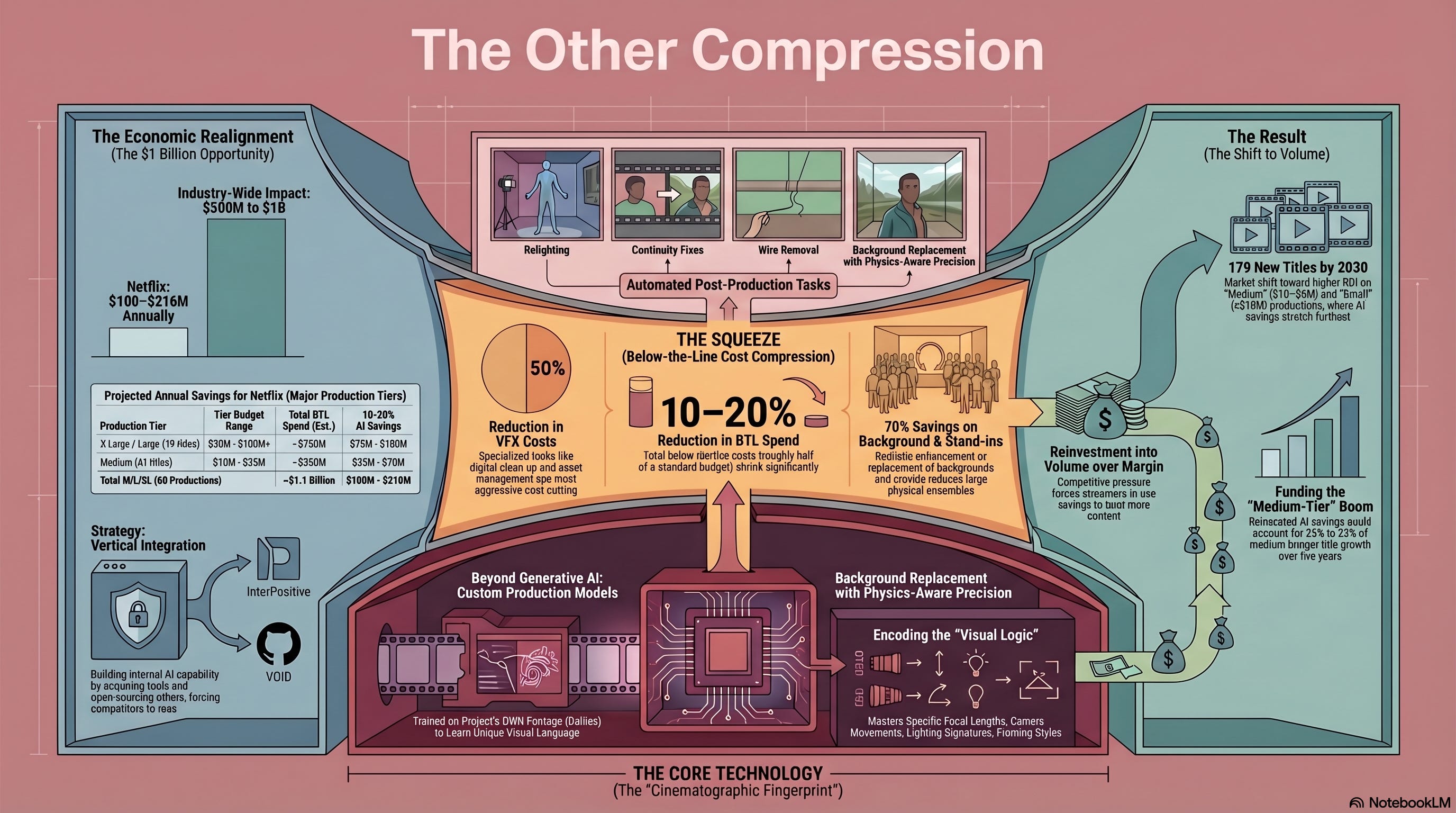
What InterPositive built is worth understanding precisely, because it isn’t what most people assume when they hear “AI filmmaking tool.” The company’s patent, filed in 2024 and analysed in detail by Stephen Follows, describes a system that trains a custom AI model on a specific production’s own dailies. Not a general-purpose generative model. A per-project model that learns the cinematographic fingerprint of that particular show — its focal lengths, camera movements, lighting signatures, framing style, and editorial logic.
Once trained, the model handles tasks that currently consume significant time and budget: relighting shots, correcting continuity errors, removing stunt wires, reframing to fix composition problems, replacing or enhancing backgrounds. The system isn’t generating footage from prompts. It’s learning a production’s visual language and applying that understanding to solve concrete post-production problems.
The cost projections in the patent filing are aggressive. InterPositive’s internal documents, reported by Deadline, claimed 10–20% savings on below-the-line costs overall, 50% reduction in VFX costs, and 70% savings on background actors and stand-ins. On a specific budget example, they projected shaving $7 million off $32.1 million in below-the-line spend.
Those are projections, not audited results. But Netflix paid up to $600 million for them, which tells you something about how the buyer assessed the probability.
Process compression, not codec compression
Next week, NAB 2026 opens in Las Vegas. The show floor will be wall-to-wall AI messaging — V-Nova demonstrating LCEVC with 50 ecosystem partners, Appear showcasing low-latency hardware encoding, two dedicated AI Innovation Pavilions anchoring the floor. Real engineering advances that reduce bandwidth costs and improve delivery quality. But they’re solving for what happens after content enters the distribution pipeline. InterPositive sits upstream of all of it. It’s compressing the production process itself.
Traditional compression reduces the number of bits required to represent a finished frame. InterPositive’s model is a compressed representation of a production’s entire visual logic — not pixels but understanding: how this show looks, how its shots are constructed, what its visual rules are. And it uses that understanding to eliminate work that would otherwise require crew, equipment, and time.
Netflix is building the toolkit
The InterPositive acquisition doesn’t exist in isolation. On April 3, Netflix open-sourced VOID — Video Object and Interaction Deletion — a physics-aware model that removes objects from video while preserving scene plausibility. In user studies, it was preferred 64.8% of the time against competitors including Runway. It’s on GitHub under Apache 2.0.
Put InterPositive and VOID side by side and a strategy emerges. One is proprietary and acquired for hundreds of millions. The other is open-sourced for free. Both compress the production process. In the language of our Six Market Forces thesis, this is Generative-AI Cost Compression (Force 1) converging with Keeping Up With Netflix (Force 3). Netflix isn’t just using AI tools — it’s vertically integrating them, building an internal AI production capability that competitors will need years to replicate.
Running the numbers
So what does this mean in practice? Sohonet’s Screen Production Index tracks 127 Netflix productions over the last twelve months. By budget tier: 4 are X-Large ($100M+), 15 are Large ($35–100M), 41 are Medium ($10–35M), 48 are Small, and 19 are X-Small. That’s 60 productions in the Medium, Large, and X-Large tiers where InterPositive’s technology could materially impact below-the-line spend — titles like 3 Body Problem ($140M), Wednesday ($80M), Bridgerton ($40M), One Piece ($110M), and Outer Banks ($25M).
Using industry-standard assumptions — below-the-line costs represent approximately half of total production budget — and applying InterPositive’s own 10–20% BTL savings range from the Deadline-reported patent filing, the arithmetic is straightforward. Across those 60 M/L/XL Netflix productions, aggregate budget totals roughly $2.2 billion. Below-the-line spend: approximately $1.1 billion. A 10–20% reduction yields $108–216 million in potential annual savings for Netflix alone.
Those are projections built on claimed numbers, not audited results. Treat them as directional. But even the conservative end — over $100 million annually on a portfolio Netflix refreshes every year — raises a question that matters more than the dollar figure itself.
Where does the money go?
There are three possible destinations for AI-driven production savings, and the split between them will define whether this is a margin story or a volume story.
The first possibility is that savings get absorbed into future budget baselines — the most common pattern in production history. Once a cost reduction is demonstrated, the line item shrinks in the next budget cycle. Productions don’t get cheaper; they get squeezed.
The second possibility is that savings improve platform profitability directly. Netflix channels that $108–216 million into live sports rights, podcast deals, games, or simply takes the margin improvement. The production ecosystem sees no incremental volume.
The third possibility — and the one worth watching — is reinvestment into additional content. If even half of those savings flow back into new commissions, that’s $54–108 million in freed capital. At Medium-tier budgets (~$20M average), that funds 3 to 5 additional productions per year. At Small-tier budgets (~$5M average), it funds 11 to 22.
Here’s why the third scenario is more likely than it might appear: competition. The Six Market Forces thesis identified Keeping Up With Netflix as a distinct force because the streaming landscape is a volume race. In a zero-sum attention market, taking savings as pure margin while competitors use AI to produce more is a strategic risk Netflix is unlikely to accept. We saw this dynamic in 2023–2024: studios that resumed production fastest post-strike captured disproportionate share. In a content race, standing still is falling behind.
The real inflection point
Now extend the logic beyond Netflix. The SPI’s January 2026 report shows total industry production value of approximately $11.7 billion across all major studios. Netflix accounts for roughly 18% of that. The industry’s tier distribution skews more heavily toward Medium than Netflix’s portfolio does — 24% of all productions are Medium-tier, compared to Netflix’s 32%. Scale the same BTL assumptions across the industry’s approximately 295 M/L/XL productions, and the numbers shift substantially: industry-wide BTL savings range from roughly $500 million to $1 billion annually.
Here’s where it connects to the broader thesis. Sohonet’s Six Market Forces framework projects that pro-grade title counts will grow from roughly 1,960 today to 2,840 by 2030 — almost entirely concentrated in Medium and Small budget tiers, with X-Large and Large titles remaining flat. The M-tier alone is projected to grow by 179 titles over five years. If AI savings reinvestment funds even 13 to 26 additional M-tier productions per year at steady state — and adoption ramps gradually — AI cost compression alone could account for a quarter to a third of the projected M-tier title growth over the next five years. At the S-tier level, the numbers are even more pronounced.
That’s not a rounding error. That’s the mechanism by which Force 1 (AI Cost Compression) translates into the volume growth the thesis projected — concentrated in exactly the budget tiers where savings stretch furthest and where streamers are competing hardest.
What to watch for at NAB and beyond
NAB next week will surface dozens of AI tools across the production and distribution pipeline. The ones worth paying closest attention to aren’t the ones with the most impressive demos — they’re the ones that compress process, not just bitrates. That’s where the economics change.
The evidence isn’t just piling up anymore. It’s being acquired, integrated, and deployed. The question from February stands, updated: is your infrastructure, your workflow, and your business model ready for what happens when the savings start flowing back into the pipeline?
Chuck Parker is CEO of Sohonet. The Screen Production Index and Six Market Forces Reshaping Hollywood report are available at sohonet.com.
Storytellers & Silicon publishes on the second and fourth Tuesdays of each month.
This is a really useful analysis. The other streamers and film studios will need roller skates to keep up with them