
The Infrastructure Squeeze
Navigating the Hybrid Cloud Production Economy

Last night I sat at Jason Fotter’s table at the HPA NET Roundtables in Universal City. Fotter — founder of BIND Studio and former CTO of FuseFX — was leading the studio-in-the-cloud discussion, and the room was full of people who build and operate production infrastructure for a living. Engineers, pipeline architects, facility operators, studio technology leads. The conversation was sharp, practical, and unresolved.
The tension surfaced immediately. Someone from the post-production side warned that costs are rising on both sides of the ledger — RAM, NVMe, and networking gear on-prem; storage, compute, and egress in the cloud. A studio engineer argued that none of it matters if the artist experience isn’t seamless — creatives shouldn’t have to know or care where their infrastructure lives. Fotter’s argument cut through both: the real promise of public cloud is elastic scale — the ability to spin up and spin down compute as a project demands it. The friction, he argued, is partly skeuomorphic. We treat the cloud like a separate computer rather than an extension of a workflow, one where specific components justify the premium of dynamic compute. But the friction is also economic: cloud costs are opaque, unpredictable, and hard to model against on-prem alternatives. And someone at the table asked the question that nobody could fully answer: is any of this even the highest-leverage cost problem in production, or are we optimising the wrong line item?
It was a room full of smart people wrestling with the economics of hybrid infrastructure — and nobody had a clean answer.
That’s because the question has changed. The industry spent a decade debating “cloud versus on-prem” as though it were a binary choice. That argument is over. The answer is “both.” But “both” has its own economics, and our industry hasn’t fully reckoned with them.
Where the industry actually sits
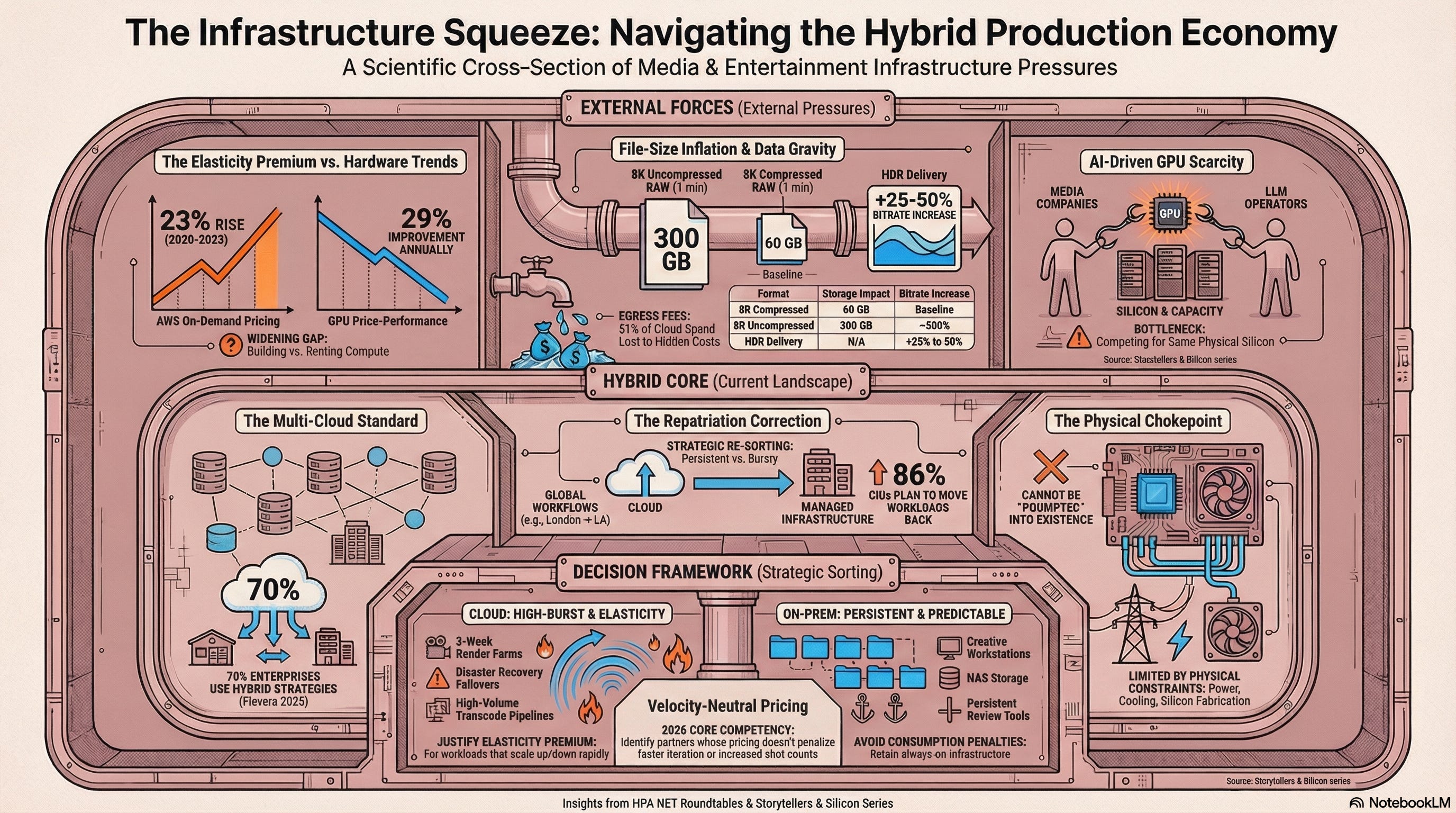
According to Flexera’s 2025 State of the Cloud report, enterprises now use an average of 2.4 public cloud providers, and 70% have adopted hybrid cloud strategies combining public and private infrastructure. This isn’t hybrid in the old sense of on-prem-plus-one-cloud. It’s multi-cloud-plus-on-prem, often with different providers handling different workflow stages. The landscape has fragmented well past the binary debate.
Meanwhile, 86% of CIOs report planning some form of cloud repatriation. That sounds like a retreat, but it isn’t. It’s a correction. Workloads are being re-sorted: bursty render and transcode stay in the cloud; persistent storage, review, and creative workstations are coming back to managed or owned infrastructure. The industry isn’t moving in one direction — it’s oscillating, and the oscillation itself has costs.
What “hybrid” means on the ground is something like this: dailies reviewed in London, VFX rendered in Montreal, conform in Los Angeles, deliverables pushed to a distributor’s cloud bucket in Virginia — all on the same production. Media workflows don’t flow “up and down” to the cloud the way traditional IT workloads do. They flow laterally — venue to facility, ingest to playout, artist to reviewer. Different stages of the workflow have fundamentally different requirements, and they belong in different places.
Three forces making the economics harder
The first is the widening gap between what compute costs to build and what it costs to rent. GPU price-performance has improved at roughly 29% per year since 2019, according to analyses of GPU benchmark-per-dollar trends. Yet hyperscaler pricing hasn’t tracked that curve. AWS on-demand compute pricing actually increased by approximately 23% between 2020 and 2023, and while selective cuts followed in mid–2025, the January 2026 GPU price hike clawed some of that back. The net effect: the underlying cost of compute keeps falling, but the price you pay on public cloud has been volatile — and in some periods, moving in the opposite direction.
This doesn’t make public cloud the wrong choice. It makes it a choice that needs to be made deliberately. The elasticity premium — the ability to burst up and tear down on demand — is entirely justified for episodic, high-burst workloads: a render farm that spins up for three weeks and disappears, a disaster-recovery failover that fires once a year, a transcode pipeline that scales with ingest volume. It makes far less sense for always-on workloads — your NAS, your creative workstations, your persistent review infrastructure. The discipline is knowing which workloads justify the premium and which don’t. Most organisations haven’t done that maths rigorously.
The second force is data gravity and the hidden egress tax. The same Wasabi survey found that 51% of media and entertainment cloud spend on object storage goes to fees — egress charges, API calls, retrieval costs — rather than actual storage capacity. That’s higher than the cross-industry average. More than half of the organisations surveyed reported IT or business delays caused directly by egress costs. Once assets land in a cloud region, the cost to move them out frequently exceeds the cost of storing them there in the first place. Productions don’t budget for this. They plan for storage and compute, then discover data movement on the invoice.
The third force is file-size inflation. 8K acquisition, ACES and HDR colour pipelines, higher frame rates, volumetric capture from LED stages — the raw data footprint per shot keeps compounding. A single minute of 8K camera-original footage in a compressed RAW codec like RED’s R3D runs roughly 60 gigabytes — and uncompressed, it approaches 300. Even at delivery-grade compression, HDR adds 25 to 50% to bitrates compared with SDR at the same resolution. This is the accelerant that makes the other two forces worse. The hyperscaler premium hits harder when there’s more data to process. Egress compounds when there’s more data to move. And AI demand for GPU and compute resources is simultaneously creating scarcity on the very hyperscaler capacity that was supposed to provide burst flexibility — media companies are now competing for the same silicon as the large language model operators.
The chokepoint nobody is watching
Doug Shapiro, in his forthcoming book Infinite Content (MIT Press, 2026), makes a compelling argument about price deflation in media. His thesis, in brief: when the cost of creating content approaches zero — as generative AI accelerates — value migrates to the scarce complements. Distribution, curation, and infrastructure.
Infrastructure is the one worth watching. Unlike distribution or curation, infrastructure capacity is physically constrained. GPUs have to be fabricated. Fibre has to be laid. Data centres need power and cooling. You cannot generate more infrastructure with a prompt. And yet the entire AI-accelerated production pipeline depends on it.
This is the squeeze. Content costs are deflating. The tools to create, iterate, and refine are getting cheaper and faster. But the infrastructure required to process, store, move, and review all of that content is facing pricing pressure from multiple directions — the structural gap in hyperscaler economics, the compounding effect of larger files, and AI-driven scarcity on burst compute. Production companies sit in the middle.
What this means heading into NAB
AI tools will accelerate iteration. That much is certain. There will be more shots, more versions, more review cycles per project than ever before. Each of those shots must be stored, moved, modified, colour-graded, reviewed, and delivered. That incremental iteration has a real cost — and if it’s priced on a consumption model, the economics of faster iteration actually work against you. The tool that made you faster also made you more expensive.
Understanding the cost components of shot creation by workflow stage — compute, storage, movement, review bandwidth — is becoming a core competency. Use public cloud where burst and elasticity justify the premium. Keep persistent workloads on infrastructure you own or lease at predictable rates. Find partners whose pricing model doesn’t penalise velocity.
That’s what the conversation at Jason Fotter’s table was really about. Not cloud versus on-prem. Not which hyperscaler wins. But understanding which workflow component belongs where, and why — and building the discipline to act on that understanding before the invoice arrives.
NAB 2026 will be wall-to-wall hybrid messaging. Every vendor on the floor will have a story about cloud-native workflows and AI-powered pipelines. The question worth asking each of them: what happens to my costs when I iterate faster?
Budget success on professional television and film projects increasingly depends on the answer.
Chuck Parker is CEO of Sohonet. The Screen Production Index and Six Market Forces Reshaping Hollywood report are available at sohonet.com.
Storytellers & Silicon publishes on the second and fourth Tuesdays of each month.
You got all of that out of a 5 minute roundtable? I need to start attending these meetings.